
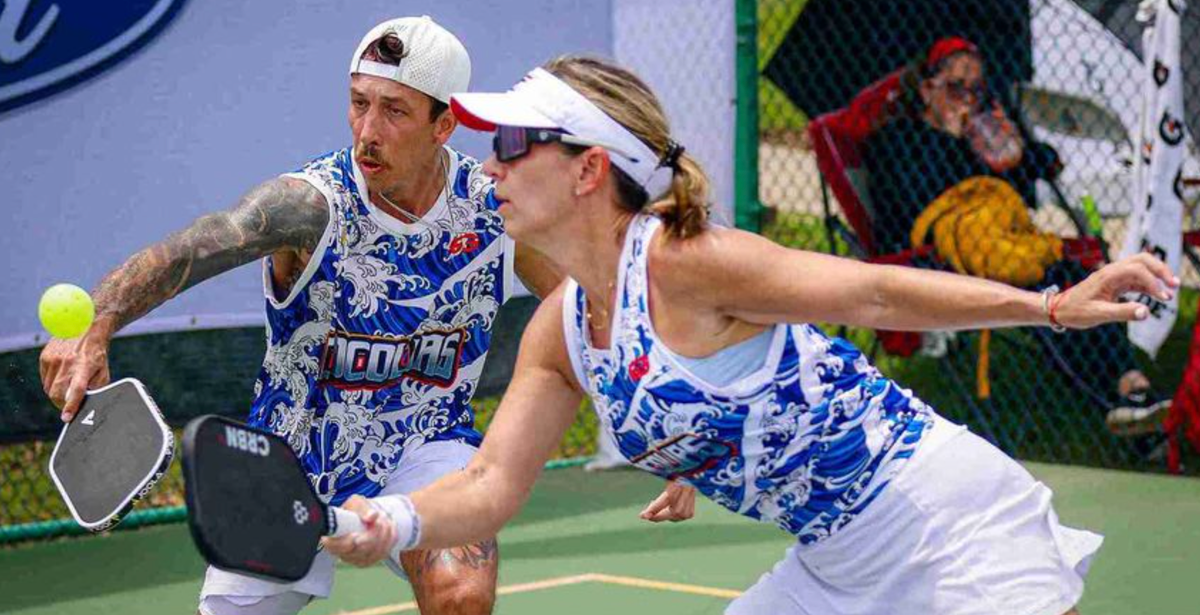
Aggressive doubles technique 4.0 pickleball is much less about hitting tougher and extra about controlling patterns, court docket positioning, and forcing opponents into shedding conditions.
On the 4.0 stage, aggressive doubles technique in pickleball shifts from “hit good photographs” to “construct higher patterns.”
The gamers who plateau right here have stable mechanics.
What they’re lacking is a system, a repeatable framework for creating stress, controlling the court docket, and forcing errors with out counting on tempo alone.
That is the place doubles will get attention-grabbing.
Love pickleball? Then you definitely’ll love our free e-newsletter. We ship the newest information, ideas, and highlights at no cost every week.
Why Aggressive Doubles Technique Separates 4.0 from 5.0 Play
The soar from 3.5 to 4.0 is generally technical. The soar from 4.0 to 4.5+ is sort of solely strategic.
At 4.0, you’ve got received your third shot drop. You’ll be able to dink cross-court and maintain it low. You reset beneath stress more often than not.
So why aren’t you profitable extra? As a result of pickleball is stuffed with patterns, and recognizing, constructing, and disrupting these patterns is the precise recreation at this stage.
The 4.0 ceiling is a sample recognition drawback. Gamers who break by it aren’t abruptly hitting cleaner drops.
They’re pondering two photographs forward. They’re creating conditions, not simply responding to them.
This is the framework that issues: each level in aggressive doubles has a sequence, serve, return, transition, NVZ battle.
At 4.0+, you want a deliberate plan for every part. Improvising the entire level is a 3.5 strategy.
Understanding methods to change the way in which you consider doubles is the place elite leisure gamers start their improve.
What Is Stacking in Pickleball (and When Ought to 4.0 Gamers Use It)?
Stacking is a court docket positioning system the place each gamers line up on the identical facet of the court docket after the serve or return, then shift to their most well-liked sides because the rally develops.
It isn’t magic, it is arithmetic. You are engineering the court docket so your stronger arms face the crosscourt angles you want.
Most 4.0 gamers know what stacking is. Most do not use it persistently as a result of they’re afraid to miscommunicate mid-point. That concern is costing them matches.
💡
The payoff is important. When a right-handed group stacks so each forehands cowl the center, they get rid of the only greatest exploitable hole in leisure doubles.
The “X” rule for overlaying the center turns into manageable with a transparent system as an alternative of a guessing recreation.
Full stacking after each serve is superior. Begin smaller: use a half-stack on the return facet solely.
The returner runs to the popular facet after the return; their associate shifts. Apply it in low-stakes video games first.
Staggering your positioning strategically is the stepping stone earlier than a full stacking system.
Doubles Stacking 101: The Idiot-Proof Positioning Technique That Wins Factors
Stacking may be the only most underrated positional instrument in doubles pickleball – and it’s method less complicated than you suppose

How Does Serve Placement Change Aggressive Doubles Technique at 4.0?
Serve placement drives all the pieces that follows.
A well-placed serve limits return angles, units up your third shot, and forces your opponent right into a defensive return.
Most 4.0 gamers serve to begin the purpose. Good 4.0 gamers serve to construct the purpose.
Weaponizing your serve at 4.0+ is not about energy. It is about location and spin. Two placements win disproportionate factors:
- Deep to the backhand nook. Most leisure gamers have a weaker backhand return. A deep ball to that nook produces a brief, floaty return, precisely what you need for a put-away third shot or a poach.
- Huge to the forehand facet. This pulls the returner off the court docket and creates a diagonal return angle your associate can poach.
Neither serve is difficult. Each require intention.
The place your associate returns to issues equally, the serve and return part is a linked system, not two unbiased photographs.
The drill: choose one placement for a complete follow session. Backhand nook solely. Watch what it does to return high quality over half-hour.
The suggestions might be quick and everlasting.
Senior Pickleball Doubles Technique After 60
Senior pickleball doubles technique is much less about velocity and extra about positioning, shot choice, and court docket IQ. Right here’s how gamers over 60 can outthink, and outplay, opponents half their age.
The Transition Zone Downside: Why 4.0 Gamers Lose Factors within the Center of the Courtroom
That is the part that separates aggressive doubles technique at 4.0 pickleball from all the pieces beneath it.
The transition zone is the stretch of court docket between the baseline and the non-volley zone. It’s the most harmful actual property on the court docket.
Extra factors are misplaced in transition than wherever else, and the error is sort of all the time the identical: attacking when you have to be resetting.
At 4.0+, the mid-court transition part requires a easy choice framework:
- Ball above the online? Transfer ahead aggressively.
- Ball at or beneath the online? Reset and transfer ahead patiently.
That is it. The issue is gamers really feel stress in transition and swing for heroes. A ball that is knee-high with tempo on it isn’t an attacking ball, it is a reset ball.
Studying to reset higher is the only highest-ROI talent funding for gamers caught at 4.0.
Pair your reset self-discipline with understanding the again third of the court docket for these moments while you genuinely cannot get to the kitchen safely.
Generally the right play is retreating, resetting from deep, and rebuilding. Forcing the advance while you’re out of place is the way you give away free factors.
Grasp the Pickleball Transition Zone: Assault or Reset
The perfect gamers on the planet aren’t simply comfy within the transition zone – they actively use it to their benefit
Is Dinking Cross-Courtroom a Passive Technique or a Weapon?
Brief reply: it is a weapon. A gradual one, however a weapon.
Cross-court dinking in aggressive doubles is not about conserving the ball in play, it is about angling your opponent out of place.
The geometry is in your favor. A cross-court dink travels over the bottom a part of the online, lands in a wider portion of the kitchen, and pulls your opponent sideways.
That sideways motion creates a spot. That hole is your assault alternative.
Turning mediocre dinks into winners means constructing a dinking sample with intent. The slice dink is especially efficient right here.
It stays low, skids by the kitchen, and generates a pop-up, the precise response you need earlier than dashing up.
The go-to slice dink deserves a everlasting spot in each 4.0+ participant’s toolkit.
This is the sequence execs use, tailored for 4.0+ gamers:
- Dink cross-court 3-5 occasions, constructing towards the sideline
- When the opponent strikes vast, redirect down the road or to the center
- Once they raise the ball above web peak, assault with a speed-up to the hip or shoulder
Understanding the stress zone contained in the dinking trade tells you precisely when this sequence has created a hittable ball.
Attacking too early offers up the sample; attacking too late lets your opponent get well.
Timing the speed-up off a positional dink sample is genuinely aggressive doubles technique.
The right way to Hit a Crosscourt Dink in Pickleball
The crosscourt dink is one in every of pickleball’s most versatile photographs, and mastering it requires understanding paddle positioning and footwork fundamentals. Study the precise approach utilized by prime gamers to regulate the online and dominate rallies.
The right way to Use the Poach in 4.0+ Aggressive Doubles
A poach is when one associate crosses to intercept a ball meant for the opposite.
At 4.0+, a well-timed poach is without doubt one of the most point-efficient strikes in doubles.
It disrupts your opponents’ rhythm, creates confusion of their communication, and places tempo on a ball they weren’t anticipating to be attacked.
The poach works greatest on predictable cross-court dinks.
While you see your opponent locked right into a cross-court sample, telegraph your poach with eye contact to your associate (not a verbal name, that ideas your hand).
Then commit totally. A half-hearted poach is worse than no poach in any respect as a result of it leaves your associate stranded and creates an open court docket.
Constructing easy ideas for doubles teamwork together with your associate consists of defining your poach indicators earlier than you play.
A fist behind the again, a foot faucet, no matter works persistently. The perfect doubles groups have two or three set communication cues.
They play chess whereas everybody else is enjoying checkers.
Your associate’s job after a poach is to right away shift to cowl the vacated facet.
That is the half that breaks down for many 4.0 groups, the poacher goes, however the associate freezes.
Drill the poach-and-shift sequence particularly. Superior shot choice in follow drills will construct the sample into muscle reminiscence sooner than match play alone.
The right way to Poach Successfully in Pickleball
Studying methods to poach successfully in pickleball is without doubt one of the quickest methods to place stress in your opponents in doubles. This information breaks down the precise timing, footwork, and indicators that flip a hesitant web participant right into a match-winning weapon.
Aggressive Doubles Patterns That Truly Win Factors at 4.0+
Idea is helpful. Precise patterns are higher. Listed below are three that translate on to wins on the 4.0 stage:
- Sample 1: Serve Huge, Poach the Return Serve vast to the forehand. Your associate (on the NVZ) watches the return lane. A large serve produces a crosscourt return, your associate poaches the center. This works particularly properly when opponents have not performed collectively lengthy and their “X” communication breaks down.
- Sample 2: Third Shot Drop, Crash on the Tender Ball Hit a high quality third shot drop. Transfer ahead. If the fourth shot is mushy and beneath web stage, reset it, do not flick. If the fourth shot is driveable (ball floats up), rip it on the non-dominant participant’s hip. Selecting drive versus drop on the fifth shot is dependent upon how properly that fourth-shot floated, let contact peak make the choice for you.
- Sample 3: Dink to Backhand, Pace-Up Center Dink persistently to the weaker participant’s backhand. Stack sufficient dinks that they begin reaching. On a barely pop-up dink, drive center, not at a physique, however by the seam between the 2 gamers. Making opponents hit tough photographs means exploiting the seam ball on the 4.0 stage, the place communication about who takes the center breaks down beneath stress.
Taking part in the chances in pickleball means utilizing these patterns as a result of they generate errors from opponents, not as a result of they really feel flashy.
Successful doubles is about manufacturing conditions, not profitable particular person exchanges on athleticism.
10 Pickleball Doubles Technique Errors Newbies Make
Most pickleball doubles gamers lose factors not due to unhealthy photographs, however due to poor positioning, weak communication, and lack of construction. Listed below are the ten pickleball doubles technique errors that separate informal gamers from constant winners.
Positioning on the Kitchen: Are You and Your Companion Truly Aligned?
Two gamers on the NVZ have to operate as one unit. Most 4.0 pairs drift.
One participant will get pulled vast chasing a dink; their associate does not alter; abruptly there is a hole down the center large enough to drive a truck by.
Positioning your self accurately on the kitchen is not nearly your ft, it is about sustaining a linked entrance relative to your associate.
Consider a string connected between your hips. When one participant strikes left, the opposite shifts left. The hole between it’s best to keep roughly paddle-length, no wider.
The T and sideline placement technique is a direct extension of this.
Your objective is to maintain balls in entrance of you, by no means allow them to get behind you, and develop into unattackable in your kitchen positioning by refusing to succeed in.
If it’s a must to attain, you are already out of place. Regulate your stance earlier than the ball arrives, not after.
Off-Ball Positioning in Pickleball: Cease Ball Watching
Most pickleball gamers suppose the purpose is determined by whoever hits the ball, however at larger ranges, off-ball positioning is what truly controls the court docket. Grasp this talent and also you’ll rework the way you play on the web.
Key Takeaways
- Stacking unlocks preferred-hand matchups. Begin with a half-stack on the return facet.
- Serve vast or deep-backhand with intention, the serve units up all the pieces that follows.
- Transition zone self-discipline means reset-first when the ball is low. Attacking low balls in transition is the commonest 4.0 unforced error.
- Cross-court dinking is a sample builder, not a survival instrument. Angle your opponents out of place earlier than you assault.
- Poach with dedication and communication. Your associate should shift to cowl.
- Three profitable patterns: serve-and-poach, drop-and-crash, dink-to-backhand-speed-up-middle.
- NVZ alignment requires fixed micro-adjustments between companions. The hole kills you.
💡
Steadily Requested Questions
What makes aggressive doubles technique totally different at 4.0 pickleball vs. decrease ranges?
At 4.0 pickleball, aggressive doubles technique focuses on sample building, court docket positioning programs, and deliberate shot sequencing quite than particular person shot high quality. Gamers at this stage have already got working mechanics, the differentiator is knowing methods to create stress by 2-3 shot mixtures, exploit positional gaps, and use instruments like stacking and the poach to regulate level construction. Decrease ranges rely extra closely on profitable particular person photographs; 4.0+ gamers win by manufactured conditions.
How do you cowl the center in aggressive doubles pickleball?
The final rule is that the participant with the forehand within the center takes center balls, however this breaks down with out communication. The simplest 4.0+ groups use a pre-agreed system, such because the “X” rule (every participant covers their facet of the court docket based mostly on which facet the ball got here from) mixed with a verbal or non-verbal name for ambiguous center balls. Stacking can simplify this by engineering each forehands towards the center on the identical time.
When must you poach in aggressive doubles at 4.0+?
Poach when your opponent is locked right into a predictable cross-court dink sample, when the returning participant is out of place, or when you’ll be able to learn the trajectory of a floating return off a large serve. At all times talk together with your associate earlier than the poach, a fist-behind-back or foot faucet sign is cleaner than a verbal name that ideas your intention. Commit totally when you determine; a half-poach creates extra issues than it solves.
What’s the greatest third shot technique for 4.0 doubles gamers?
The third shot drop stays the most secure high-percentage possibility, however making your third shot more practical at 4.0+ means various placement and tempo quite than hitting the identical drop each time. Intention for the backhand facet of the weaker returner or the sideline closest to the participant who simply returned. A 3rd shot drive is viable when the return is brief and sitting up, in any other case, the drop-and-transition strategy offers you extra time to succeed in the NVZ.
How do you cease opponents from attacking the center in doubles pickleball?
Closing the center hole requires synchronized positioning on the NVZ. Each companions ought to keep inside roughly paddle-length of one another, alter laterally collectively because the ball strikes, and by no means let one participant attain throughout the opposite’s facet. Pre-agreeing on who takes the center (forehand rule or verbal name) removes hesitation. You can even use serve and return placement to cut back crosscourt return angles that naturally funnel balls towards the seam.
