
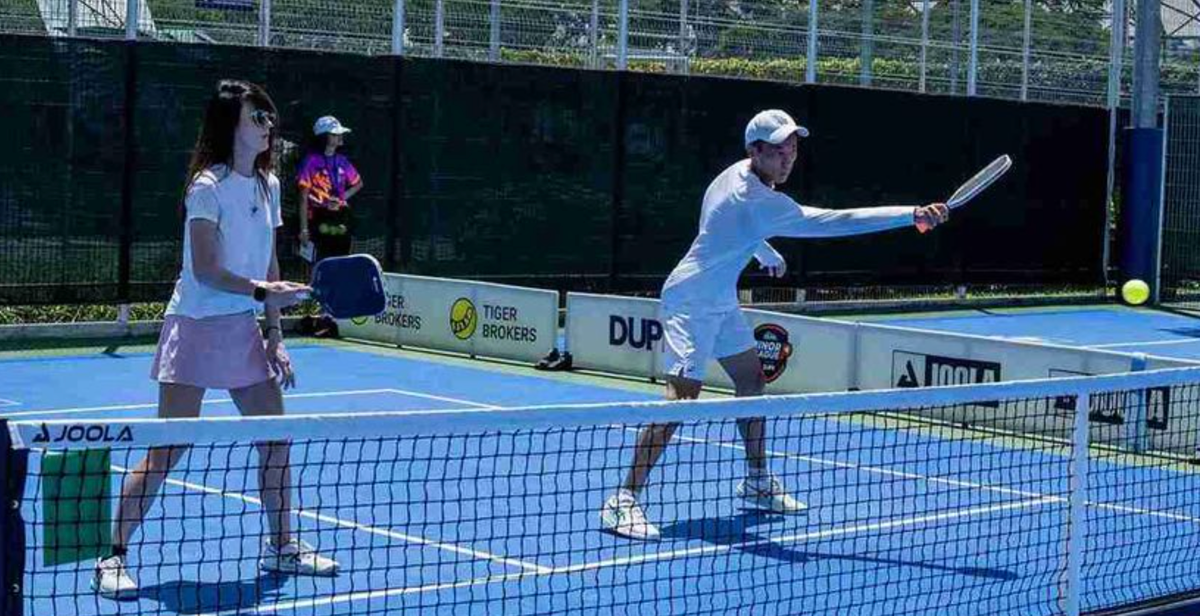
Pickleball combined doubles technique comes down to 1 factor greater than every other: the place you and your associate are standing. Get the positioning proper (stacking, center protection, and transition zone motion) and also you flip a two-person workforce right into a single, coordinated weapon.
Pickleball combined doubles technique begins earlier than you ever hit a ball : it begins with the place you set your ft.
Most groups lose factors not as a result of their photographs are dangerous, however as a result of their positioning is off.
Improper facet, unsuitable depth, unsuitable angle. The opposite workforce would not even must do something particular; they only purpose the place you are not.
Fixing that? That is what this text is for.
Love pickleball? Then you definately’ll love our free e-newsletter. We ship the newest information, ideas, and highlights free of charge every week.
What Makes Pickleball Combined Doubles Technique Completely different?
Combined doubles has its personal positioning logic, its personal tactical conventions, and, truthfully, its personal psychological layer in comparison with normal doubles.
The most important structural distinction: most combined doubles groups have an influence hole between companions.
One participant is usually extra aggressive, extra skilled, or has a more durable drive.
Good doubles technique is about designing your positioning in order that participant sees extra balls, not fewer.
Pickleball Psychological Sport: 7 Methods Professionals Use Below Strain
Choking, the yips, and match nerves will not be about expertise. A psychological efficiency coach who trains tour execs shares the pickleball psychological sport habits that hold you regular when it counts.
On the leisure stage, opponents nearly at all times goal the participant they understand as weaker. On the professional stage, it is the identical factor, simply quicker.
Watch any prime combined doubles match and you may see groups methodically directing site visitors towards one participant till they generate an error.
Your positioning both protects that participant or exposes them.
The opposite key factor: courtroom geometry and stacking.
Due to how serving rotation interacts with most popular sides, combined doubles groups must actively handle which participant finally ends up the place.
This requires a pre-agreed system, not improvisation.
How Ought to You Stack in Pickleball Combined Doubles Technique?
Stacking is the only most vital positioning tactic in pickleball combined doubles technique.
Get snug with it and your workforce turns into structurally more durable to assault. Ignore it and also you’re on the mercy of the rating.
What Is Stacking in Pickleball?
Stacking is when each gamers line up on the identical facet of the courtroom earlier than the serve or return, then shift to their most popular sides as soon as the ball is in play. It lets groups management which participant lands on which facet, whatever the rating rotation. Stacking is totally authorized beneath the USA Pickleball 2025 Official Guidelines, no rule restricts the place gamers stand earlier than the ball is in play. With out stacking, you are locked into no matter facet the scoring system places you on. With stacking, you select.
The commonest use case: a right-handed workforce needs to maintain each forehands down the center. If the rating places the stronger participant on the left facet (advert courtroom), stacking lets them begin there after which reduce throughout to the proper after the serve. This is how kitchen positioning connects to that motion.
5 Pickleball Exercise Routine Drills to Enhance Agility
A centered pickleball exercise routine is the quickest approach to shut the hole between the place your sport is and the place you need it to be. These 5 agility drills goal the precise motion patterns that win factors.

When Ought to You Stack, and When Ought to You Not?
Stack when you’ve a transparent power imbalance: one participant has a considerably stronger forehand, or one participant is a dominant attacker who advantages from being in particular positions. Additionally stack when your pure rotation places you in an uncomfortable spot after the serve.
Do not stack if it is creating hesitation. A nasty stack with communication breakdowns is worse than simply taking part in your pure facet. Stacking is a software, not a rule. Some groups play higher with out it. The professionals use it continuously; watch how the highest pairs place off the serve and you may see the sample clearly.
One key element: the non-stacking participant (the one staying put) is accountable for the huge ball. If each gamers reduce to the middle throughout a stack, the opponent will rip it huge each time. Outline your protection earlier than you serve.
💡
Who Covers the Center in Pickleball Combined Doubles Technique?
That is the query that causes extra arguments between companions than every other.
This is the direct reply: the participant with the forehand within the center takes the center.
That is the rule nearly all high-level groups use, and it really works as a result of forehands generate extra energy, are extra constant beneath stress, and supply wider cross-court redirection angles than backhands, a precept backed by courtroom sport biomechanics analysis printed within the Journal of Sports activities Sciences.
The Forehand-Takes-Center Rule
When each gamers are on the NVZ and a ball splits the center, the participant whose forehand faces that hole will get the shot. For 2 right-handed gamers, that is normally the participant on the left (even) facet. Their forehand crosses the middle. For a right-left mixture, it will get extra contextual, however the precept holds.
This piece on courtroom protection in doubles breaks down the geometry intimately. The brief model: center balls go to the forehand, huge balls belong to whoever is already positioned there. Easy. Constant. Adopted by nearly no leisure workforce, which is why the center is the place most factors get gained.
💡
Poaching and Calling Your Shot
Poaching (crossing in entrance of your associate to steal a ball) is authorized, efficient, and underused. The USA Pickleball 2025 Official Guidelines place no restrictions on a participant shifting to any a part of the courtroom throughout a rally. A well-timed poach on the NVZ can finish a rally instantly. Nevertheless it solely works in case your associate is aware of it is coming (or not less than would not freeze if you transfer).
Name “mine” early and loud.
In case your associate calls it first, respect it and get well. Good teamwork in doubles comes all the way down to pre-agreed conventions, not improvised reactions.
Resolve earlier than the purpose begins who has the center in a given formation. Then stick with it.
Aggressive Doubles Technique 4.0 Pickleball: Patterns That Win
Aggressive doubles technique 4.0 pickleball is much less about hitting more durable and extra about controlling patterns, courtroom positioning, and forcing opponents into shedding conditions.
How Do You Transfer as a Unit in Pickleball Combined Doubles Technique?
This is the factor most leisure groups utterly miss: positioning in pickleball combined doubles technique is not about the place you stand at one second.
It is about how you progress collectively throughout each second of the rally.
Give it some thought this manner. You and your associate are linked by an invisible rope about 10 ft lengthy.
Whenever you transfer left, they transfer left. Whenever you advance to the kitchen, they advance with you. Whenever you get pushed again, they get pushed again.
If that rope goes slack (one participant on the NVZ, one participant in no-man’s-land), the opposite workforce wins. Each time.
Navigating the Transition Zone Collectively
The transition zone (additionally referred to as no-man’s-land or the mid-court) is the realm between the baseline and the NVZ. It is probably the most harmful place to cease. Analysis on racket and paddle sport motion patterns, together with biomechanical research on courtroom positioning listed on PubMed, persistently reveals that mid-court gamers face the widest vary of shot angles with the least response time, producing larger error charges than gamers at both the baseline or NVZ.
The objective is at all times to get each gamers to the NVZ concurrently. The transition sport is roofed extensively right here: the important thing precept is that it is best to solely advance when the ball you hit offers you time to maneuver. A very good third-shot drop buys that point. A floated drive doesn’t.
If one participant will get compelled again, each gamers ought to reset reasonably than leaving one stranded. That is the invisible rope once more. It feels counterintuitive if you’re the participant on the NVZ: you do not need to retreat. However splitting the courtroom vertically is a demise sentence towards any workforce that is aware of methods to exploit it.
Staying Related Throughout Lateral Motion
On the NVZ, the linked motion rule applies horizontally. When the purpose strikes to your left, each gamers shade left. Not dramatically, just some steps to shut the plain hole with out opening a brand new one on the opposite facet. Mid-court positioning ideas cowl this geometry effectively.
Not more than a paddle’s width of hole between you and your associate on the NVZ. Something wider is an invite for a speed-up proper by way of the center.
Pickleball Doubles Communication: Calls Each Staff Wants
Pickleball doubles communication is the hidden variable that separates groups that grind out wins from groups that implode on massive factors. Study the precise calls, indicators, and habits that hold you and your associate shifting as one unit on the courtroom.
What Pickleball Combined Doubles Technique Do the Professionals Use?
Watch a high-level combined doubles showcase for thirty minutes and you may see the identical positioning ways run repeatedly.
- The ATP (Round-the-Put up). When a dink pulls you huge, your opponent can legally go across the put up with out clearing the web. That is explicitly permitted beneath Rule 11.M of the USA Pickleball 2025 Official Guidelines. The counter: keep disciplined on the NVZ. Lunging after a large ball opens the center for the put-away.
- The Erne. One participant positions close to the put up and jumps to take a volley from exterior the NVZ, authorized beneath USA Pickleball 2025 Official Guidelines offered the participant lands out of bounds with out touching the NVZ. The defensive reply: differ your dink placement and assault into the physique if you see somebody creeping towards the put up.
- Pace-ups focusing on the weaker participant. The offensive workforce will use deception to direct quick assaults on the much less dominant associate. Counter: shade your formation to offer that participant higher angles and hold their backhand protected.
- The reset sport. Professional combined doubles is not simply assaults. The professionals will reset 8-10 photographs in a row, ready for the proper ball. Place your self to reset, not simply to assault.
Combined Doubles Technique: Rachel Rohrabacher’s Information
Rachel Rohrabacher breaks down the basics of combined doubles technique in a masterclass with Kyle Koszuta. From understanding every participant’s position to studying your opponent’s motion, this information covers every thing it’s essential to elevate your combined sport.
Frequent Positioning Errors in Combined Doubles
A number of patterns present up at each ability stage. Fixing them is quicker than creating new photographs.
- 1. Each gamers stacking to the identical facet with out assigning the huge ball. This creates a large hole that any competent opponent finds in about two factors. Assign the huge protection each single time you stack.
- 2. One participant tenting on the NVZ whereas the opposite is caught in transition. This shot-or-positioning breakdown explains the price. You are primarily taking part in 1v2 till your associate catches up.
- 3. Not shading towards the participant being focused. When opponents begin routing every thing at your associate, each gamers want to regulate, not simply the participant beneath stress. Shade the formation towards that facet, shut the center, and make them work more durable for a similar angle.
- 4. Poaching with out calling it. Fast tips about teamwork in doubles: talk early, talk usually. Shock poaches result in two gamers gazing one another whereas the ball lands between them.
- 5. Standing too removed from the NVZ line after advancing. Get all the best way up. Hovering two ft again from the kitchen offers your opponent a better angle and makes your volleys weaker. Crowd the road. It is uncomfortable at first, but it surely’s the proper place.
Doubles Stacking 101: The Idiot-Proof Positioning Technique That Wins Factors
Stacking could be the only most underrated positional software in doubles pickleball – and it’s means less complicated than you suppose
Key Takeaways
- Stacking allows you to management which participant is on which facet whatever the rating. Use it to maintain stronger forehands within the center.
- The forehand takes the center rule applies to most conditions on the NVZ; the participant with the center forehand wins extra exchanges.
- Transfer as a linked unit : if one participant shifts, the opposite should shift too. The “invisible rope” idea is the best means to consider it.
- In pickleball combined doubles technique, focusing on the weaker participant is normal at each stage; your positioning should account for this stress.
- The transition zone is probably the most harmful place to cease shifting. Preserve advancing collectively, or reset collectively. By no means cut up.
💡
Ceaselessly Requested Questions
What’s the primary positioning rule in pickleball combined doubles technique?
Each gamers ought to purpose to succeed in the non-volley zone (NVZ) line collectively as shortly as potential. As soon as there, transfer as a unit: when one participant shifts laterally, the opposite shifts to match. An important rule on the NVZ: the participant whose forehand faces the center takes center balls.
Ought to the stronger participant at all times cowl the center in combined doubles?
Usually, sure, however “stronger” right here means the participant with the higher forehand within the center place, not merely the extra expert participant total. A right-handed participant on the left (even) facet normally has the forehand angled towards the center, making them the pure selection for center balls in a right-right workforce formation.
When ought to a combined doubles workforce use stacking?
Use stacking when the default scoring rotation places gamers on the unsuitable facet, usually if you need to hold a dominant forehand within the center, or if you need to keep away from placing a weaker participant in a high-pressure place. If stacking is inflicting confusion or hesitation, simplify and play your pure facet till the mechanics really feel automated.
How do you cease opponents from focusing on the weaker participant in combined doubles?
First, shade your formation so the weaker participant has higher defensive angles and their backhand is not uncovered down the road. Second, have the stronger participant poach extra aggressively to intercept directed assaults. Third, hold opponents from getting snug by various your third-shot choice. They’re much less prone to goal anybody once they’re coping with unpredictable serve patterns and drops.
What is the greatest positioning mistake leisure combined doubles groups make?
Splitting the courtroom vertically: one participant up on the NVZ, one participant caught within the transition zone. It turns each rally right into a 1v2 state of affairs for the participant caught in no-man’s-land. Each gamers ought to advance collectively on a high quality third shot and retreat collectively when the state of affairs requires it. The invisible rope idea: if one participant strikes, each gamers transfer.
