
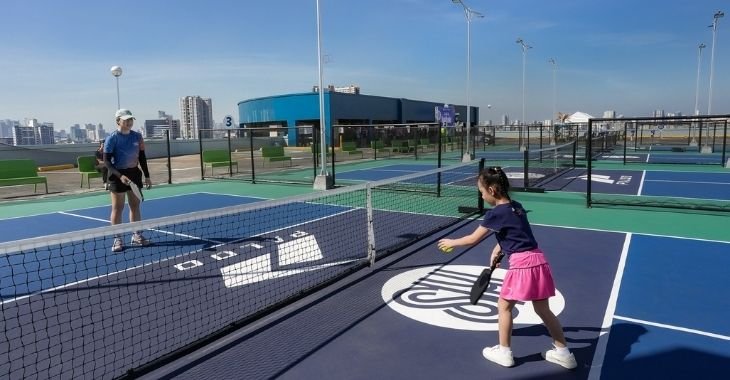
Pickleball courts usually are not simply filling up. They’re filling up the remainder of the mall too.
What started as a leisure guess is turning into certainly one of SM Supermalls’ most strategically important enterprise strikes. The nation’s largest mall operator will not be merely constructing pickleball courts to experience a sporting development—it’s utilizing the game to basically rethink what a mall is for, how lengthy folks keep inside one, and what makes them come again.
Joseph Francis Silva, SM Sports activities and Leisure Facilities senior assistant vp for operations, laid out the numbers and the logic in clear phrases on ANC’s Enterprise Outlook. The corporate at the moment operates 89 pickleball courts throughout 29 malls—up from 86 simply weeks in the past—and expects to surpass 100 courts earlier than the top of 2026.
“We’re proud to say that we’re nonetheless rising,” Silva mentioned. “Within the subsequent few months, we are literally nonetheless constructing extra courts.”
The Two-Hour Impact
The enterprise case for pickleball will not be merely about courtroom bookings. It’s about what occurs after the match ends.
In line with Silva, pickleball gamers sometimes keep contained in the mall for no less than two extra hours after ending their video games—consuming, hydrating, looking for sporting items, and socialising with the folks they simply performed with. That prolonged dwell time is exactly what mall operators have been chasing as e-commerce continues to peel away transactional purchasing journeys that used to drive foot visitors.
“It’s a minimal of two hours. After taking part in, they hydrate, then they hang around with associates—they select the place to eat,” Silva mentioned.
When customers store on-line, they’re optimising for comfort. After they come to a mall to play pickleball, they’re optimising for expertise—and expertise spending tends to cascade throughout tenants. The restaurant subsequent to the courts advantages. So does the sporting items retailer, the bubble tea store, and the café on the stroll again to the automotive park.
SM Supermalls logged 1.4 billion visits in 2025—averaging 115 million monthly—regardless of softer shopper spending and broader financial headwinds. The corporate attributes continued foot visitors, partly, to experience-led sights together with sports activities amenities, leisure ideas, and neighborhood occasions. Pickleball, by Silva’s personal account, has grow to be a serious driver of that system.
“Sure, it’s a serious line merchandise already in our enterprise, and it retains on rising,” he mentioned.
The Generational Play
One of many arguments SM makes for pickleball’s endurance—versus earlier health developments that burned brilliant and pale—is the game’s uncommon cross-generational enchantment.
“You possibly can have three generations in a single courtroom—you have got your lolo, your lola, and their grandkids taking part in,” Silva mentioned.
That isn’t advertising language. It’s observable actuality on SM’s courts, the place gamers starting from retired seniors to college college students to working professionals occupy the identical facility, usually on the identical time. A sport that binds generations reasonably than dividing them by age group is uncommon—and for a mall operator whose enterprise mannequin is determined by drawing as extensive a shopper base as attainable, it’s enormously beneficial.
Probably the most putting proof of demand got here from SM’s latest facility. 4 E-Com Middle’s pickleball courts, which opened on 1 Might, have been absolutely booked by means of August inside two weeks of opening.
“After two weeks, it was full till August,” Silva mentioned.
Redefining the Mall
SM’s pickleball technique is an element of a bigger repositioning that the corporate has been accelerating in recent times. The standard mall mannequin—anchor tenants surrounded by retail, punctuated by a meals courtroom—is beneath strain from structural shifts in shopper behaviour that predate and postdate the pandemic. Customers who as soon as made a mall journey to purchase garments or electronics can now do this from their sofas. What they can’t do from their sofas is play pickleball, share a post-match meal, watch a match last, or really feel a part of a sporting neighborhood.
SM is leaning into that hole intentionally.
“Luxurious now will not be actually on the product. It’s on the experiences,” Silva mentioned.
That philosophy is reshaping how SM designs and evaluates its amenities. Quite than measuring success purely by means of rental revenue from retail tenants, Silva mentioned the corporate now assesses how sports activities infrastructure influences the whole mall ecosystem—packed courts, absolutely booked tournaments, and thriving communities have grow to be key indicators guiding the place new funding goes.
It is usually influencing how SM thinks in regards to the sport past the power stage. The corporate plans to broaden tournaments, construct out teaching programmes, and enhance entry to coaching—with a longer-term imaginative and prescient of contributing to aggressive growth.
“The essential factor right here is to make it extra accessible first. When you have got entry to those amenities, the champions comply with,” Silva mentioned.

SM Seems Ahead
Trying 5 years forward, Silva mentioned SM needs pickleball to be a mainstream sport within the Philippines—and desires SM to be the corporate that helped make it so.
“In 5 years, we need to see pickleball turning into a mainstream sport within the Philippines, and SM turning into a serious catalyst,” he mentioned.
The courts are filling up. The eating places subsequent to them are filling up. The reserving calendars are full by means of summer season. The gamble has paid off—and SM will not be accomplished betting.
