
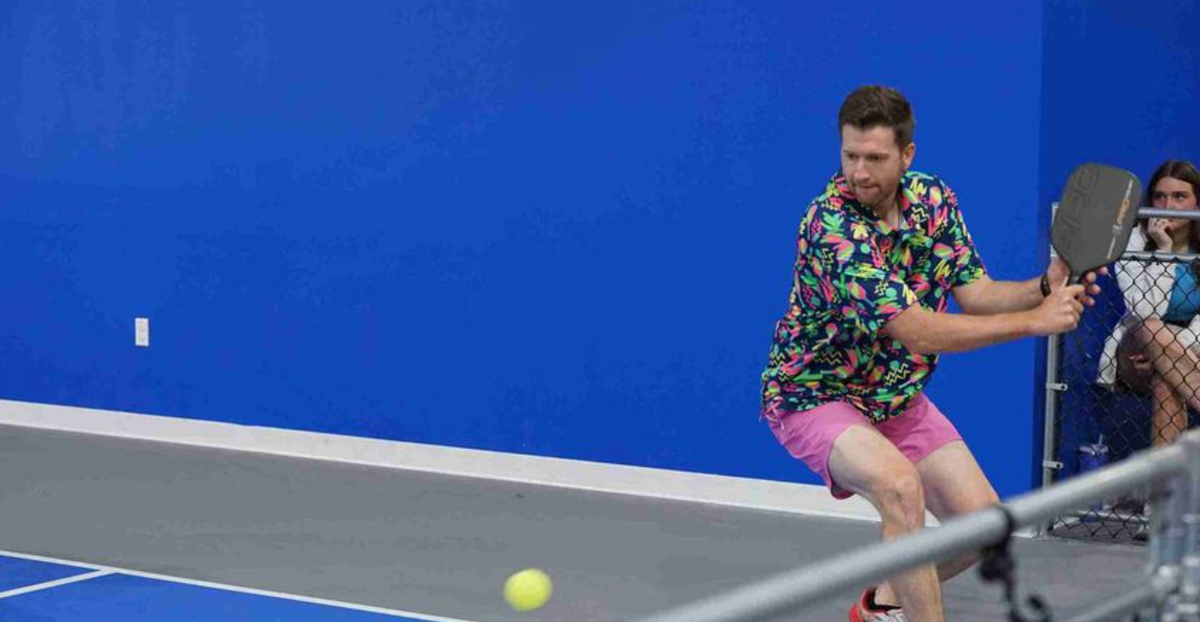
Disguise dinks pickleball gamers depend on comes down to 1 precept: identical physique setup, completely different shot path. Grasp this ability and your opponents will cease studying your dinks earlier than you even hit them.
Studying to disguise dinks in pickleball is the only quickest technique to go from predictable to harmful on the kitchen line.
Your opponents aren’t studying your paddle. They’re studying your physique.
The second you give them a distinct look each time you put together to dink, the jig is up.
However hit that very same setup whether or not you are going crosscourt, down-the-line, or into the center? Now they’re guessing. And guessing in pickleball is shedding.
Love pickleball? You then’ll love our free e-newsletter. We ship the most recent information, suggestions, and highlights without cost every week.
What It Means to Disguise Dinks in Pickleball
Disguised dinking means presenting an equivalent pre-contact image to your opponent no matter the place you propose to put the ball.
Identical stance, identical backswing, identical paddle face angle at eye degree, after which making the directional choice at or simply earlier than contact.
Most intermediate gamers telegraph each shot with out figuring out it.
They open their shoulders early for the crosscourt, drop their elbow for the road shot, or rotate their hips towards the goal earlier than the ball even arrives.
Opponents on the kitchen are skilled to select up precisely these cues, and as soon as they’ll, your dinks grow to be hittable.
Disguise is about eradicating these cues. The aim is not to trick anybody, it is to present them nothing to learn till it is too late to react.
Why Your Dinks Are Extra Readable Than You Assume
Here is the factor: most gamers suppose their dinks are unpredictable as a result of they range the position.
They are not improper, completely different targets are good. But when the physique language is completely different for every goal, the position variation means nothing.
The opponent sees the shoulder flip, steps left, and you’ve got already handed them the purpose.
Analysis on anticipatory cue use in racket sports activities constantly reveals that elite gamers make shot-direction choices based mostly on physique kinematics, not ball flight.
A 2025 research within the Journal of Sports activities Sciences confirmed that superior athletes in net-based sports activities decide up directional cues from opponent hip and shoulder orientation a mean of 180ms earlier than contact.
That is practically two full tenths of a second of response time you are freely giving in case your setup is not impartial.
Pickleball deception suggestions begin with understanding this: your physique tells the story earlier than your paddle does.
💡
The Identical-Setup System: The best way to Construct a Impartial Dinking Platform
The inspiration of disguised dinking is a impartial platform, a prepared place that does not decide to any path. Here is what it seems to be like:
- Toes parallel to the web, shoulder-width aside. Not angled towards one facet. That is the bottom every little thing else builds on.
- Paddle out in entrance at mid-body peak. Not loaded to 1 facet. Not dropped. Centered.
- Eyes on the ball, not your goal. The second your eyes drift to your supposed touchdown spot, your shoulder follows.
- Contact level straight in entrance of the physique. The path change occurs via refined wrist and forearm changes at contact, not via physique rotation.
That is precisely the system JW Johnson makes use of along with his uncommon dinking approach. His setup seems to be the identical on nearly each dink.
You do not know if he is going crosscourt or down the road till the ball is already shifting. That is not a present, that is skilled repetition.
Pickleball Dinking 101: Small Swings, Huge Outcomes
You’re not attempting to hit winners from the kitchen. You’re attempting to create conditions the place your opponent makes a mistake or offers you a ball you possibly can assault
The best way to Really Change Course With out Altering Your Setup
That is the place most guides cease quick. They inform you to maintain a impartial setup however do not clarify how to redirect the ball with out tipping your hand. Here is the breakdown:
- Wrist angle at contact is your main path device. A barely open face (wrist rolled again) sends the ball crosscourt. A flatter, closed face pushes it down the road. The adjustment is measured in levels, not in arm motion. Flip these mediocre dinks into winners by working towards contact-point changes with no different setup change.
- Contact timing is your secondary device. Taking the ball barely early (out in entrance of your lead foot) tends to redirect crosscourt. Taking it barely later, nearer to your hip, favors the road. Each contacts can come from the identical paddle preparation.
- Swing pace creates misdirection. A deceptively sluggish strategy with a fast contact pop freezes opponents who’re already leaning. That is particularly efficient when dinking into patterns, you determine a tempo, then break it proper once they’ve dedicated.
Kitchen Line Angles Pickleball: Shot Placement System
Kitchen line angles in pickleball are the distinction between dinking to outlive and dinking to win. This shot placement system reveals you precisely the way to use angles to maneuver opponents, create openings, and take management on the non-volley zone.

Does Disguise Dinking Work the Identical on Each Sides?
Sure, however the mechanics are barely completely different for backhand vs. forehand, and most gamers are weaker on one facet.
The forehand disguise depends on wrist pronation at contact.
The backhand model requires a extra deliberate suppression of the elbow flare that naturally telegraphs path.
The backhand volley and the backhand dink share a typical leak: the elbow.
When gamers go down-the-line on the backhand facet, the elbow typically pulls again and away from the physique.
Prepare your self to maintain that elbow tucked, no matter path, and you’ve got closed a significant learn in your opponent.
Spend further drill time on whichever facet breaks your impartial setup first. For many gamers, that is the backhand.
The best way to Disguise Your Velocity-Up Shot in Pickleball
Your opponent depends on studying small adjustments in your motion, grip, and paddle place to anticipate your pictures. Eradicate these tells and also you’re in management.
How Professionals Use Sample Setup to Make Disguise Even Tougher to Learn
Here is one thing the high-level gamers perceive that intermediate gamers do not: disguise is extra highly effective when it lives inside a recognizable sample.
You needn’t hit a random spot each time. You want your opponent to suppose they’ve recognized your sample, after which hit some place else.
The shot choice and creation course of on the professional degree seems to be like this: set up a crosscourt dink sequence for 3 or 4 exchanges, let your opponent begin leaning, then redirect down the road with the very same setup.
They transfer the improper path. You win the alternate.
That is how doubles positioning will get exploited by disguised dinks. A
well-placed line dink in opposition to an opponent who’s overplaying crosscourt protection creates a large open lane. But it surely solely works if they can not see it coming.
3 Patterns That Separate Good Pickleball Gamers From Nice Ones
The hole between good and nice pickleball gamers comes down to 3 repeatable patterns that create strain as a substitute of reacting to it
Why Does Disguise Matter Extra at Increased Ranges?
At 3.5 and beneath, most dinks are gained or misplaced on consistency and placement. Gamers aren’t studying your physique but.
However above 4.0, each opponent on the kitchen is scanning you for cues. At 4.5 and above, your physique language is being learn in actual time.
The transition sport is the place disguise begins to matter even earlier than you attain the kitchen.
Gamers who cannot set up impartial setups earlier in a rally get caught exposing their intent earlier than the dinking alternate even begins.
In case your aim is to grow to be unattackable on the kitchen, disguise is a part of the formulation.
The tougher you might be to learn, the extra your opponent has to react as a substitute of anticipate. And a reacting opponent makes extra errors.
The three Phases of Smarter Dinking in Pickleball
Dinking isn’t difficult, however it requires apply and consciousness. Subsequent time you’re on the court docket, deal with these phases and watch how your sport adjustments.
How Can You Apply Disguised Dinking?
The simplest drill is the “identical setup, name the path” train. Here is the way to run it:
- Rally crosscourt dinks with a companion in a impartial setup
- Your companion calls “line” or “cross” randomly as you are about to contact the ball
- You redirect to the known as goal with out altering your pre-contact place
- Do 10 minutes per facet, then change
This forces you to make the directional choice on the final second, which is strictly what disguise requires.
A unique form of reset drill works properly paired with this as a result of it trains you to get better impartial after an aggressive alternate.
Pair it with backspin dinking apply. Heavy topspin locks you right into a swing path that telegraphs path.
A flatter or backspin dink offers you extra wrist freedom to redirect late.
Pickleball Dinking Method: The Full Newbie’s Information
This information breaks down every little thing you should learn about correct dinking kind, grip, stance, and drills to dominate on the kitchen line.
Key Takeaways
- Disguise dinks pickleball technique facilities on one precept: equivalent setup, last-second redirection.
- Opponents learn your physique kinematics, shoulder angle, hip rotation, elbow place, not your paddle face.
- A impartial platform (parallel ft, centered paddle, contact in entrance) is the muse of each disguised dink.
- Course is managed via wrist angle and speak to timing, not physique rotation.
- Sample manipulation amplifies disguise: set up a pattern, then break it with the identical setup.
- Each forehand and backhand disguise are trainable. The backhand elbow is the most typical inform.
- Disguise issues most above the 4.0 degree, the place opponents actively learn pre-contact cues.
💡
Steadily Requested Questions
What does it imply to disguise dinks in pickleball?
To disguise dinks in pickleball means presenting the identical physique setup and paddle preparation for a number of shot instructions so your opponent cannot anticipate the place the ball goes. The redirection occurs via refined wrist and forearm changes at or simply earlier than contact, not via seen physique motion. It is probably the most efficient methods to win kitchen rallies with out hitting tougher.
How do I cease telegraphing my dink path?
Begin by recording your self throughout a dink rally and search for the second your physique adjustments earlier than contact. Frequent tells embrace shoulder rotation, elbow flare, and early eye motion towards the goal. Construct a impartial stance and apply making contact-point changes from that very same setup. The third shot drop basis applies right here too, neutrality in setup interprets throughout a number of pictures.
Is disguised dinking tougher on the backhand facet?
For many gamers, sure. The backhand naturally creates an elbow flare when redirecting down the road, which is a readable cue. Retaining that elbow tucked via contact, no matter the place you are sending the ball, takes deliberate repetition. Drill the backhand dink particularly with the “known as path” train to shut that hole quicker.
Can newbies study to disguise their dinks?
Novices can begin constructing the habits, however disguised dinking is most precious as soon as your fundamental dink is constant and managed. For those who’re centered on simply clearing the web, including directional disguise too early can disrupt your mechanics. Get your kitchen positioning and dink consistency strong first, then layer within the disguise work.
How does disguise work in another way in doubles versus singles?
In doubles, disguised dinks are particularly efficient as a result of they power each opponents into uncertainty. A well-hidden line dink to the odd nook whereas your opponents are leaning crosscourt can pull certainly one of them utterly out of place. In singles, the geometry is easier, however the opponent has extra court docket consciousness. Altering how you consider doubles consists of understanding how shared protection gaps get exploited by disguise.
