
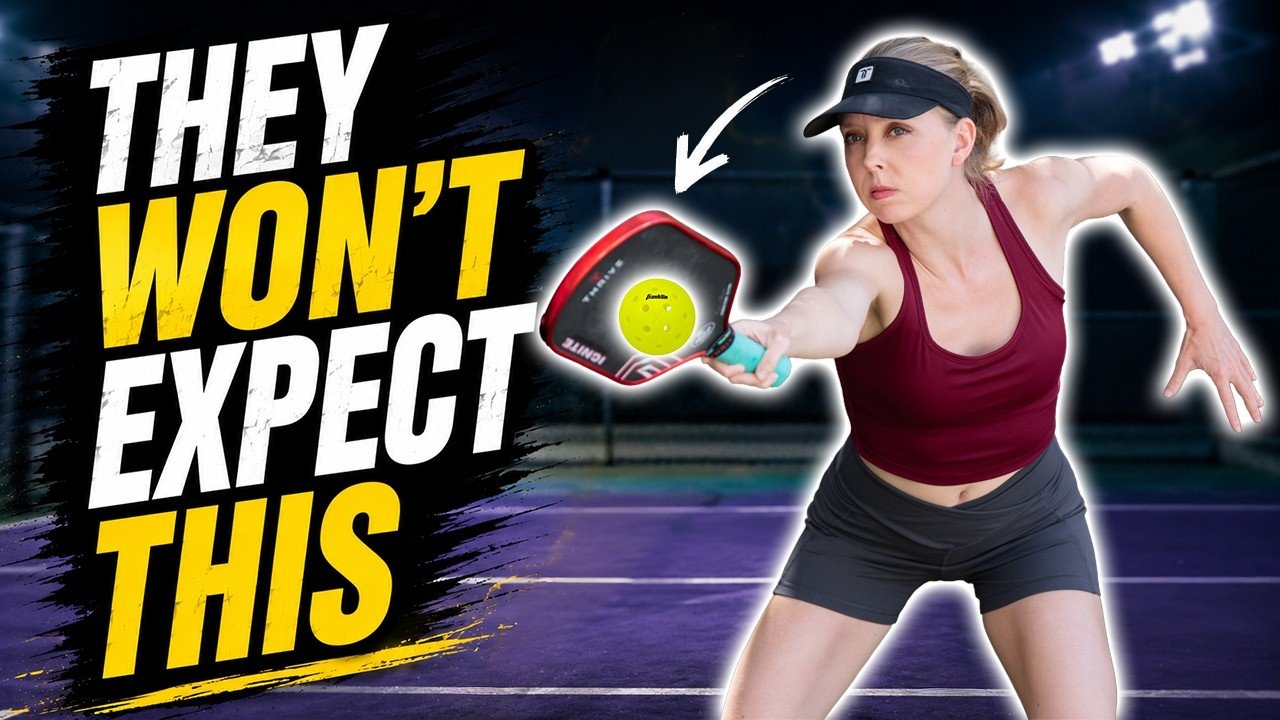
Your forehand speed-up would not need to sail lengthy or crash into the online. A forehand speed-up requires exact mechanics, physique positioning, and timing to turn into a dependable weapon in your sport.
The forehand speed-up is without doubt one of the most misleading photographs in pickleball, nevertheless it’s additionally some of the irritating to grasp.
You arrange what seems to be like a dink, then speed up via the ball to catch your opponent off guard. When it really works, it is stunning.
When it would not, the ball both buries itself within the internet or flies three toes previous the baseline.
In case your forehand speed-ups really feel inconsistent or wristy, you are not alone.
Most gamers battle with this shot as a result of they’re making the identical mechanical errors again and again. The excellent news? These errors are fixable.
In a current teaching breakdown, Cori Elliott from the Dink Pickleball channel labored with a participant named Malik to diagnose and proper the precise points holding again his forehand speed-up sport.
The session reveals the core issues that plague intermediate gamers and the step-by-step fixes that really work.
Love pickleball? Then you definitely’ll love our free e-newsletter. We ship the newest information, ideas, and highlights totally free every week.
The 4 Errors Killing Your Forehand Velocity-Up
When Malik first demonstrated his forehand speed-up, Elliott instantly noticed the culprits.
His largest points weren’t sophisticated or obscure. They have been the identical 4 errors that present up in gamers at each stage.
Why Your Forehand Velocity-Up Must Look Like a Dink
This is the factor about an ideal forehand speed-up: it ought to be disguised.
Your opponent should not see it coming till the ball is already previous them.
Elliott emphasizes this level repeatedly throughout the teaching session. The setup for a forehand speed-up ought to be an identical to your dinking movement.
You maintain the paddle the identical approach, place your toes the identical approach, and bend your knees the identical approach.
The one distinction is that on the final second, you speed up via the ball as a substitute of softly blocking it again.
This disguise is what makes the shot so efficient.
Your opponent reads a dink and begins transferring ahead, anticipating a comfortable ball. As an alternative, they get a tough, flat assault that they cannot react to in time.
However this is the place most gamers go fallacious: they attempt to disguise the shot by utilizing their wrist. They suppose a refined wrist flick will conceal the acceleration. It will not.
In truth, it does the alternative. A wristy forehand speed-up seems to be precisely like what it’s: a determined try so as to add tempo. It is telegraphed, inconsistent, and simple to learn.
The true disguise comes out of your physique place and your paddle path.
Should you’re in a correct dinking stance with bent knees and the paddle tip down, your opponent cannot inform what you are about to do.
The acceleration occurs via your core and your ahead momentum, not via your wrist.
💡
The Mechanics That Really Work
Elliott breaks down the forehand speed-up mechanics right into a easy, repeatable sequence.
That is the muse that Malik practiced all through the session.
- The first step: Get behind the ball. Place your toes in order that your physique is behind the contact level. This provides you stability and choices. Should you’re beside the ball or in entrance of it, you are already in bother.
- Step two: Bend your knees. Consider it like doing a squat. Your knees ought to be noticeably bent, and your weight ought to be on the balls of your toes. This low place is the place all of your energy comes from.
- Step three: Maintain the paddle tip down. Your paddle ought to be in a prepared place with the tip pointing towards the bottom. This is similar place you’d use for a dink.
- Step 4: Push ahead and brush up. As you speed up via the ball, you are pushing ahead along with your core and legs, not pulling along with your arm. On the final second, you sweep up barely so as to add topspin and management. Your paddle ought to cease at your prepared place once more, not comply with via throughout your physique.
- Step 5: Keep low via contact. That is crucial. Many gamers arise as they swing, which kills consistency. You want to keep that low place all through the contact level.
The result’s a shot that appears like a dink however travels with tempo and precision. It is flat, it is managed, and it is repeatable.
Off the Bounce vs. Out of the Air
A forehand speed-up can are available in two kinds: off the bounce and out of the air. The mechanics are practically an identical, however there are refined variations that matter.
Off the bounce, you will have extra time to arrange. The ball bounces, you get into place, and also you look ahead to it to barely descend earlier than you hit it.
This timing is essential. You are not hitting the ball on the best way up; you are hitting it because it’s coming down. This provides you a greater contact level and extra management.
Out of the air, you are hitting the ball earlier than it bounces. This requires sooner reactions and barely totally different positioning.
Elliott recommends holding the paddle decrease and staying even decrease via contact.
The movement is similar windshield wiper motion, however you are executing it from a extra compact place.
One adjustment Elliott made with Malik was transferring his grip larger up on the paddle for out-of-the-air speed-ups.
This can be a small element, nevertheless it made an enormous distinction in management.
By choking up on the grip, Malik gained higher command of the paddle and will execute the kitchen line assault with extra precision.
The Grip Adjustment That Modifications All the things
Most gamers grip their paddle the identical approach for each shot. Elliott challenges this assumption, particularly for the forehand speed-up.
For out-of-the-air speed-ups, transferring your grip larger up on the paddle offers you considerably higher management.
You are nearer to the paddle head, which suggests you will have extra leverage and a smaller margin for error.
This is the reason skilled gamers are more and more choking up on their grips for internet play.
Malik had been gripping his paddle on the very backside of the deal with his complete pickleball profession.
When Elliott steered transferring up, Malik was skeptical. However after only a few makes an attempt, he felt the distinction instantly.
The shot turned extra managed, extra repeatable, and extra misleading.
This can be a small adjustment that may have an outsized affect in your sport.
Should you’re struggling along with your forehand speed-up, strive experimenting along with your grip place. You is likely to be stunned at how a lot it helps.
Timing Is All the things
The largest revelation in Elliott’s teaching session is how a lot timing issues for a forehand speed-up. You possibly can’t velocity up each ball. In truth, you should not.
The best ball to hurry up is what Elliott calls a “lifeless dink.” This can be a ball that bounces excessive and floats softly over the online.
It is sitting up, ready to be attacked. If you get a ball like this, you will have choices. You possibly can velocity it up, you possibly can angle it, or you possibly can hit it down the road.
But when the ball is low, if it is coming at you quick, or if it isn’t arrange completely, you must in all probability dink it once more.
Attempting to hurry up a foul ball is how you find yourself hitting it into the online or crusing it lengthy.
Malik struggled with this initially. He was making an attempt to hurry up each ball, whatever the setup.
Elliott needed to remind him repeatedly: look ahead to the correct ball. If you get that lifeless dink, that is once you speed up.
This persistence is what separates good gamers from nice ones.
A forehand speed-up is a weapon, however like all weapon, it’s important to know when to make use of it.
The Deception Issue
One of the satisfying moments within the teaching session comes when Malik executes an ideal forehand speed-up that appears precisely like a dink till the second of contact.
Elliott instantly acknowledges it and praises the deception.
“That appears like a dink,” Elliott says. “That is what I am speaking about.”
That is the aim. Your forehand speed-up ought to be so effectively disguised that your opponent commits to transferring ahead earlier than they notice what’s occurring.
By the point they see the tempo, it is too late to react.
The deception comes from three issues: your physique place, your paddle path, and your timing.
If all three are aligned along with your regular dinking movement, your opponent will not see the speed-up coming.
They’re going to learn a comfortable shot and begin transferring in, solely to have the ball blow previous them.
This is the reason the wrist motion is so damaging. A wristy forehand speed-up seems to be totally different from a dink. Your opponent can see it coming.
The shot loses its most beneficial asset: shock.
If you wish to discover ways to make your assaults fully unreadable, finding out 3 misleading pickleball photographs is the pure subsequent step.
Apply the Movement First
Elliott would not leap straight into stay rallies with Malik. As an alternative, they spend time practising the movement in isolation. This can be a essential step that many gamers skip.
Earlier than you attempt to velocity up balls in a rally, you must groove the mechanics.
You want to really feel what a correct forehand speed-up movement seems to be like. You want to perceive the distinction between a wristy swing and a body-driven swing.
Elliott has Malik observe the movement with no ball, simply to get the texture of it.
Then they observe with Elliott tossing balls, so Malik can focus completely on mechanics with out worrying concerning the rally.
Solely after the movement feels pure do they transfer into stay observe. This development is what permits Malik to make actual enhancements.
He is not simply hitting balls; he is constructing muscle reminiscence.
Should you’re working in your forehand speed-up, take this strategy. Spend time on the mechanics earlier than you are concerned concerning the outcomes. The consistency will comply with.
💡
Often Requested Questions
What’s a forehand speed-up in pickleball?
A forehand speed-up is a disguised assault shot hit from the kitchen space that accelerates a comfortable alternate into a tough, flat drive. It is designed to catch your opponent off guard by mimicking the setup of a regular dink.
What is the distinction between a forehand speed-up and a drive in pickleball?
A forehand speed-up is a managed assault from the kitchen or midcourt that accelerates a comfortable dink right into a tougher shot. A drive is a full-power shot from the baseline. The speed-up is designed to be misleading and arrange the subsequent shot, whereas a drive is supposed to finish the purpose instantly.
Why does my forehand speed-up go into the online?
The most typical motive is that you are hitting the ball too low or too early in its bounce. Anticipate the ball to barely descend earlier than you make contact. Additionally test your knee bend and be sure you’re staying low via the shot. A low contact level mixed with upward brush will enable you clear the online.
Ought to I exploit the identical grip for forehand speed-ups as I do for dinks?
For off-the-bounce speed-ups, sure. For out-of-the-air speed-ups, think about choking up on the grip barely. This provides you higher management and a smaller margin for error once you’re hitting the ball earlier than it bounces.
How a lot tempo ought to I placed on a forehand speed-up?
Begin at about 60 p.c tempo. This lets you give attention to mechanics and consistency reasonably than making an attempt to hit a winner. As you get extra comfy with the shot, you possibly can progressively enhance the tempo. The aim is a managed assault, not a full-power blast.
Can I forehand speed-up a ball that is under the online?
Technically sure, nevertheless it’s dangerous. The decrease the ball, the tougher it’s to clear the online with tempo. Typically, you wish to velocity up balls which might be at or above internet peak. If the ball is low, it is normally higher to dink it once more and look ahead to a greater alternative.
