
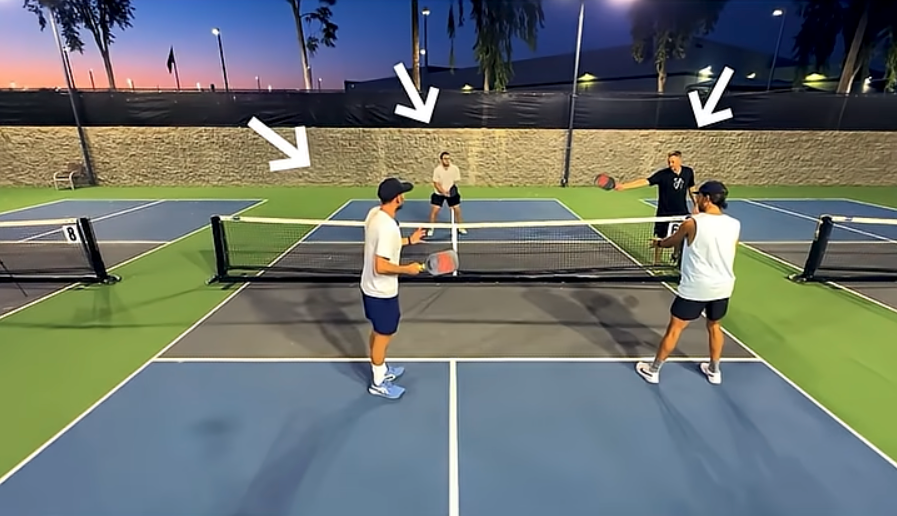
Being focused is not a loss of life sentence. It is truly a possibility to point out your opponents you have acquired extra methods up your sleeve than they bargained for.
You understand that feeling, proper? You are in a doubles match and all of a sudden you notice the opposite workforce has figured you out.
- They’re hammering your backhand.
- Each ball is coming your manner.
- Your companion’s mainly watching from the sidelines when you’re getting completely labored over.
It is irritating, demoralizing, and truthfully, it occurs to everybody sooner or later.
Being focused is not a loss of life sentence. It is truly a possibility to point out your opponents you have acquired extra methods up your sleeve than they bargained for.
Kyle Koszuta not too long ago broke down precisely the best way to deal with this example in a tactical masterclass that is value your consideration.
The Setup: Understanding Why You are Being Focused
Let’s begin with the apparent. If the opposite workforce is persistently attacking you, they’ve made a calculation.
Perhaps they’ve recognized you because the weaker participant on the courtroom. Perhaps they’ve seen your backhand is susceptible. Or your forehand dinks tends to sail excessive. Or possibly they simply know that concentrating on one participant creates chaos and forces errors.
Koszuta makes use of a sensible demonstration together with his companion Tyler as an instance this precise situation. He is relentlessly attacking Tyler’s backhand aspect, and Tyler’s caught in a defensive crouch, making an attempt to maintain the ball in play. Sound acquainted?
The stress is actual.
Once you’re being picked on, your choices really feel restricted. You are reacting as an alternative of appearing. You are making an attempt to outlive the rally as an alternative of controlling it.
That is when panic units in, and panic results in unforced errors.
💡
The First Escape Route: Pace It Up
Your preliminary intuition is perhaps to hurry one thing up on the weaker participant, however Koszuta factors out that this is not at all times the reply. In case your opponents are dinking properly and preserving the ball low and tight, you do not have a lot to assault. Rushing up a ball that is already troublesome to deal with simply provides them one other alternative to place you away.
So what occurs when the dinking is so good that the ball is mainly unattackable?
You could possibly attempt a lob, but when the ball is sitting proper on the internet, popping it up is a recipe for catastrophe. You are mainly handing them a straightforward overhead.
That is the place most gamers get caught. They’ve exhausted their apparent choices and really feel like they’re out of solutions.
Keep away from These 3 Lethal Errors to Grasp Aggressive Dinking
The aggressive dink isn’t about overpowering your opponent. It’s about creating stress by placement, utilizing deception to maintain them guessing, and understanding when to assault versus when to reset
The Center Ball: A Lure, Not a Resolution
When Koszuta asks Tyler what he’d do, Tyler suggests hitting it to the center. It sounds logical, proper? The center of the courtroom is the most secure place to hit, and it forces your opponents to speak. However here is the catch: hitting it to the center does not truly relieve the stress.
Koszuta demonstrates this by persevering with to assault Tyler even after the ball goes center. The stress does not disappear simply since you modified the route. Your opponents can nonetheless goal you. They’ll nonetheless make you uncomfortable. The center ball is a short lived reprieve, not an answer.
The Actual Reply: Down the Line
Now we’re attending to the good things. The primary reputable escape route is hitting the ball down the road.
This might sound counterintuitive as a result of down-the-line dinking is usually thought-about trickier than crosscourt dinking. The space is shorter, and there is much less margin for error.
However here is why it really works:
Once you hit it down the road, your opponent’s pure intuition is to hit it again crosscourt.
Most gamers favor dinking crosscourt as a result of the web is lowest within the center, and you’ve got extra room for error. By hitting down the road, you are forcing them to decide that goes towards their consolation zone.
In the event that they do hit it again down the road, you have acquired an alternative choice ready.
7 Pickleball Errors Conserving You From 5.0: Professional Fixes to Degree Up Your Recreation
These aren’t sophisticated technical changes that require months of apply. They’re elementary shifts in the way you method the sport.

The Recreation-Changer: The Ernie and the Change
That is the place Koszuta’s tactical brilliance actually shines. In case your opponent retains hitting it again down the road, you may step over and hit an Ernie. This forces your opponent to hit a crosscourt dink, which suggests your companion is now concerned within the rally.
And that is the entire level. You were not simply making an attempt to win the rally. You have been making an attempt to disrupt the sample and get your companion again into the motion.
Once you hit the Ernie, your opponent is all of a sudden feeling stress from three instructions: you are proper subsequent to them, your companion is in entrance of them, and now they must make a troublesome crosscourt dink whereas feeling crowded.
Even when they handle to hit dink, your companion is now in place to assault or proceed the rally from a place of power.
The stress has shifted. You’ve got gone from being the goal to being the architect of your opponent’s discomfort.
💡
Why This Issues Past the Courtroom
What Koszuta is actually educating right here is the distinction between reacting and strategizing.
Once you’re being focused, your first intuition is to panic and attempt to hit a winner. However the perfect gamers perceive that typically the aim is not to win the rally instantly. It is to shift the dynamics, contain your companion, and create a scenario the place your opponents must make troublesome choices.
That is the form of tactical considering that separates good gamers from nice ones. It isn’t about having the largest forehand or the quickest palms. It is about understanding courtroom geometry, studying your opponents’ tendencies, and executing a plan that places them in uncomfortable positions.
