
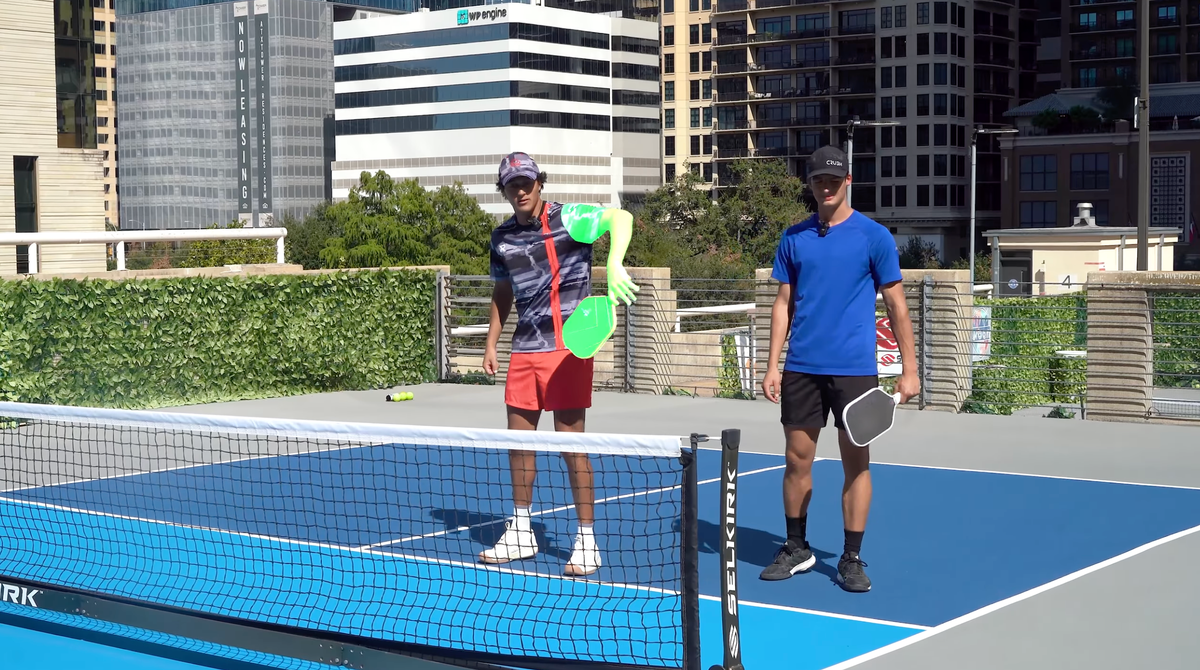
There’s this second that occurs to nearly each pickleball participant. You are on the kitchen line, somebody fires a speedup proper at your shoulder, and abruptly your arm contorts in a approach that appears and appears like you have to have simply picked up a paddle for the primary time.
You recognize the place. The dreaded rooster wing. It is awkward, it is weak, and the ensuing shot normally ends with the ball both crusing lengthy or dying within the web.
APP professional Jack Munro lately teamed up with up-and-comer Elliott Schupp to interrupt down precisely why this occurs and, extra importantly, the best way to repair it.
Seems, it is all about the way you’re positioned earlier than the ball even comes at you.
The Downside With Sitting Backhand
This is what most novice gamers do: they camp out in a backhand-ready place. Their paddle’s already cocked to the left (for righties), and so they’re dedicated to hitting all the things, and I imply all the things, with a backhand counter.
Munro explains that whereas this strategy has its deserves (you do not have to suppose, you’ll be able to take balls earlier when you slide accurately, and also you eradicate the guesswork), it creates an enormous vulnerability. When that speedup involves your forehand aspect, you are caught.
“If I get jammed in my rooster wing, then I am simply going to pop it up or shank it into the online.”
And there is one other drawback: if you slide to cowl that forehand aspect together with your backhand, you are out of place for the subsequent ball. You’ve got basically given up court docket positioning to hit a shot that is already compromised.
💡
The Impartial Place Benefit
So what is the various? Sitting impartial.
As a substitute of committing to at least one aspect, you keep balanced within the center and react to the place the ball truly goes. This implies you’ll be able to open up your forehand when the ball involves that aspect, turning what would’ve been a weak rooster wing right into a reputable weapon.
“Now you are turning a weak point right into a energy,” Munro explains.
“Now you might have a forehand volley right here as a substitute of making an attempt to rooster wing or making an attempt to take it out entrance with the backhand.”
The advantages stack up shortly:
- You do not have to slip and abandon your court docket place
- You possibly can shield your line whereas staying centered
- You change a susceptible spot into an offensive alternative
However here is the catch, and Schupp demonstrates this superbly within the video: you’ll want to use an japanese or semi-western grip to make this work. A continental grip will not provide the wrist flexibility to correctly open up on that forehand counter.
Get a Grip: The Totally different Methods You Can Maintain Your Pickleball Paddle
Except you might have a background in racquet sports activities, you may not understand that there are numerous paddle grips. We run by way of the choices and enable you to decide which is true on your sport.
The Mechanics That Make It Work
Munro breaks down three important parts for executing this forehand counter:
Maintain your elbow tucked. That is non-negotiable. In case your elbow drifts exterior your physique, you are simply chicken-winging your forehand as a substitute of your backhand, which is arguably worse. Gamers like JW Johnson excel at this as a result of their elbow stays glued to their physique, making it straightforward to punch ahead.
Brief backswing. Like most counters, this shot calls for a compact movement. Take a giant backswing and you will be late, crusing balls 10 toes lengthy. A brief punch enables you to get well and reload quicker. You are again to impartial earlier than the subsequent ball arrives.
Let the paddle face do the work. This is the place the forehand counter actually shines in comparison with the backhand. If you open up in your forehand aspect, your paddle naturally faces down with none additional wrist manipulation. On the backhand aspect, it’s important to break your wrist considerably to angle the paddle down. The forehand counter routinely places the ball at your opponent’s toes, precisely the place you need it.
Three Pickleball Drills Disguised as Video games
Pickleball mini-games mix technique, health, and enjoyable whereas sharpening important expertise corresponding to consistency, decision-making, and psychological toughness.

The Psychological Sport of Staying Impartial
The most important problem is not the mechanics. It is the decision-making. If you sit backhand, you do not have to suppose. However if you sit impartial, you’ll want to learn the ball and select between forehand and backhand in a break up second.
Munro’s resolution? Do not sit in any respect. Simply keep impartial and react.
“My first intuition is to go to the ball,” he explains.
“They will pace up at me and I am not guessing. Regardless of the place they hit it, I am all the time going to be on that ball.”
It is a refined however essential distinction. As a substitute of pre-committing to a aspect and hoping you are proper, you are coaching your self to reply to what truly occurs. For those who guess unsuitable, you do not have time to get well and nonetheless hit a strong counter.
It really works for the professionals. For the remainder of us, the trail ahead ought to be clear: cease tenting out in your backhand, begin sitting impartial, and switch that awkward shoulder shot right into a energy. Your opponents will not know what hit them, or extra precisely, the place you are going to hit them.
