
Cease simply hitting the ball. Begin fascinated by why you are hitting it, the place it is going, and what your opponent is anticipating.
Most gamers step on the court docket and simply… hit the ball. No technique. No plan. Simply response after response, level after level, till somebody wins and somebody loses.
However what separates the gamers who persistently win from those that do not comes down to 1 factor: intelligence. It is all about understanding the sport at a deeper stage.
That is precisely what Tanner Tomassi breaks down in his newest video. With a 6.0 score and two APP event wins underneath his belt, Tanner has spent hundreds of hours drilling and competing on the highest ranges.
Now he is distilling that have into seven concrete, actionable ideas that may remodel how you consider the sport.
1. The Internet-Wire Rule: Do not Velocity Up a Useless Ball
When your opponent nicks the web throughout a dink rally and the ball lands in your facet, your intuition is likely to be to assault it. Velocity it up. Finish the purpose proper there. However Tanner says that is precisely flawed.
Here is why: when a ball hits the web, it loses all its momentum and velocity. Making an attempt to hurry up a lifeless ball is “subsequent to not possible to make,” in accordance with Tanner.
As a substitute, he recommends utilizing that second as a possibility to take management of the rally. Hit an aggressive dink to set your self as much as win the purpose. It is a small adjustment, but it surely’s the form of factor that separates amateurs from professionals.
Video: 3 Professional Methods to Cease Dropping Pickleball Palms Battles
Subsequent time you’re in a firefights, you gained’t simply be reacting. You’ll be considering. You’ll be positioning. You’ll be prepared.
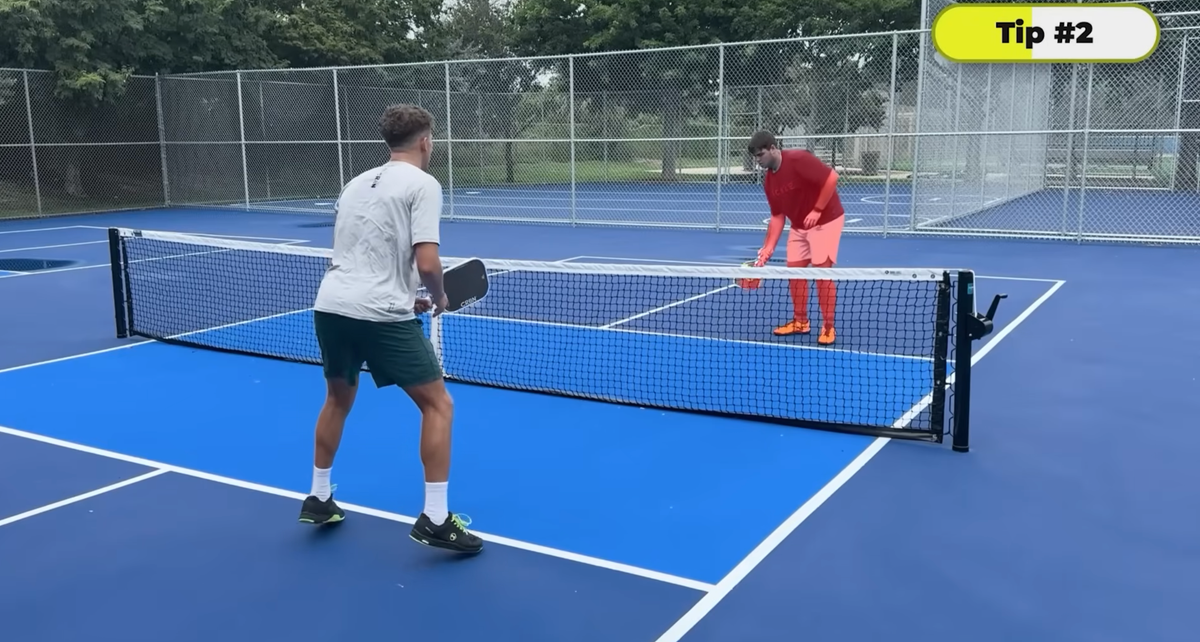
2. The ‘Maintain’ Deception: A Reliable Cheat Code
If you’re in a dink rally and also you get a lifeless ball (one which sits up), most gamers rush to dink it again instantly. However the professionals? They maintain their paddle beneath the ball for an additional second. That pause creates deception.
However Tanner takes it additional.
He explains that if you maintain, you are additionally studying your opponent’s positioning. Are they leaning towards their backhand? Anticipating a speed-up? When you perceive what they’re anticipating, you are able to do the other. Velocity it as much as their rooster wing. Lob them once they’re braced for an assault. Tanner claims he has a couple of 90% success charge on the hold-into-lob mixture.
That is not simply deception; that is management.
For the Excellent Lob, It Helps to Be a Little Ruthless
A well-struck lob can get you out of a difficult level or pour gasoline on a routine dink rally. All of it comes all the way down to deception, timing, and selecting on the weaker opponent.

3. Drive vs. Drop: Know When to Assault
The third shot is essential in pickleball, and realizing whether or not to drive or drop could make or break your level. Tanner breaks this down into clear situations.
- Hit a drive when the return bounces brief and excessive within the court docket, or when your opponent hits an aggressive deep return that has you off your again foot. In these conditions, driving provides you a better subsequent shot to drop.
- But when the return is shallow and low, or if it is deep however tender, drop it. Driving a tender ball will not offer you a lot benefit anyway.
It sounds easy, but it surely’s the form of decision-making that occurs in milliseconds throughout a match. Getting it proper persistently is what separates aggressive ranges.
💡
4. Dealing with Nerves: Put Strain on Them As a substitute
Here is one thing that does not get talked about sufficient in pickleball: psychological sport administration.
Tanner’s perception is refreshingly simple; your opponents are simply as nervous as you might be. Regardless of the extent, from newbie to professional, everybody feels the identical butterflies.
So how do you counteract that? Switch the stress.
- If you’re nervous, hit third shot drives at about 70% energy as a substitute of trying drops that’ll sail.
- Make your opponent deal with your shot as a substitute of you making an attempt to execute a troublesome one whereas shaking.
- Set a rule along with your associate that you will dink a minimum of 10 balls earlier than dashing up.
Typically, by the point you attain that tenth ball, your nervous opponent will make a mistake. You’ve got simply turned your nerves into their downside.
3 Patterns Prime Professionals Use to Plan A number of Photographs Forward
Anticipation is every little thing in pickleball. Use these three pro-proven situations to learn your opponents and put your self able to make a excessive proportion, profitable play.
5. Professional Patterns: Assume Two Steps Forward
The vast majority of gamers attempt to run round and discover their forehand. It is a pure intuition. However professionals use this predictability in opposition to them.
Tanner explains the sample:
- Dink two balls out large to situation your opponent that you are going large.
- On the third ball, go to their inside foot.
- Now they’re off-balance, their return comes again extra impartial, and you’ve got countless choices.
That is chess-level considering. You are not simply hitting the ball; you are setting traps.
You are conditioning your opponent to count on one factor so you are able to do one other. Because the match progresses and you retain utilizing this sample, your opponent turns into more and more confused. They’re on ice skates, as Tanner places it.
Professional Michael Loyd’s ‘Two-Factor Rule’ for Hitting Constant Pickleball Counters
At any given second, it is best to solely be involved concerning the two almost certainly photographs your opponent can hit. That’s it. It sounds difficult at first, but it surely’s really liberating.
6. Profitable the Fourth Ball: Apply Most Strain
The toughest shot in pickleball is hitting a reset from the center of the court docket. If you happen to’re not making use of stress on the fourth ball, you are giving your opponent a free trip into the kitchen.
The psychological guidelines is easy:
Can you’re taking the ball out of the air? If sure, do it. If no, flip sideways, step again, and drive the ball such as you’re enjoying tennis.
You wish to hit it exhausting sufficient to drive them to hit that troublesome reset. That is the way you create alternatives to place the ball away.
Heads up: tons of of hundreds of pickleballers learn our free publication. Subscribe right here for leading edge technique, insider information, professional evaluation, the newest product improvements and extra.
7. Studying Opponents: Reverse Engineer Their Play Type
This is likely to be crucial tip of all. You have to dissect your opponent’s play fashion and use it in opposition to them. Tanner provides two examples.
- In case your opponent makes use of a variety of two-handed backhand dinks, they’re most likely not seeking to attain into the kitchen and flick balls. So shrink the court docket, lean in, and take their ball out of the air aggressively. They are not a menace there.
- On the flip facet, in case your opponent is crowding the kitchen line and attacking every little thing, their weight is ahead. Lob them. Physique bag them. They cannot get again for a lob as a result of every little thing’s so ahead.
Understanding these patterns earlier than the match even begins means you possibly can stroll in with a sport plan tailor-made to their weaknesses and your strengths.
The Greater Image
Pickleball, at its core, is a considering particular person’s sport. The bodily abilities matter, positive. However the psychological edge, the flexibility to learn conditions, anticipate actions, and execute deception; that is what separates the nice from the good.
These seven ideas aren’t simply tips. They’re frameworks for understanding play smarter. Whether or not you are working in your third shot choice or studying to learn your opponent’s positioning, every of those ideas builds towards a extra full, extra clever strategy to the sport.
Cease simply hitting the ball. Begin fascinated by why you are hitting it, the place it is going, and what your opponent is anticipating. That is if you’ll actually begin to outsmart each opponent you face.
Push & Block: Find out how to Play Sensible Protection on the Kitchen Line
Quite than combat fireplace with fireplace if you’re outmatched on the kitchen line, the sounder strategy is to calm issues down and get again to impartial footing.
